
READING MUSIC 1
By Mary Jane Gormley
Note: this is the first in a series of four educational articles on the basics of reading music, intervals and notation. These building blocks were originally presented by Mary Jane Gormley as a workshop for harmonica players, but they are a valuable guide for anyone wanting to learn to read music. The print-ready PDF of this article can be downloaded here.
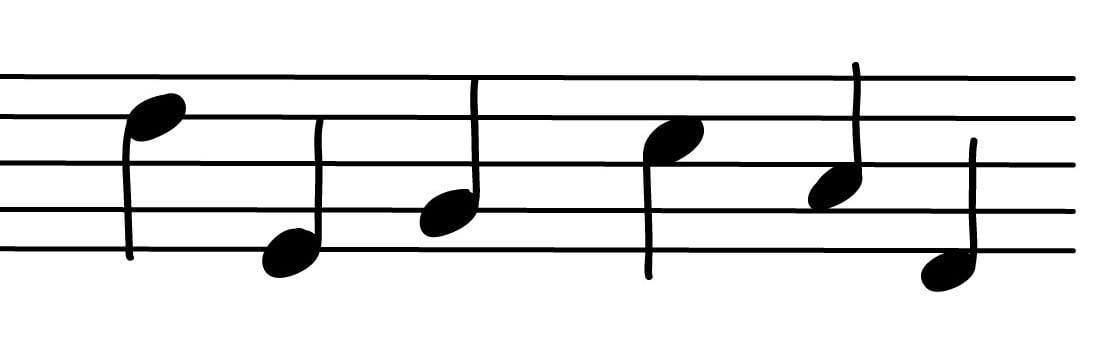
Music notation is on a staff of five lines with four spaces between them. Note heads are either on a line, like beads on a string, or in a space. Start at the left; read toward the right. Higher-sounding notes are nearer the top of the page. Note stems can go up or down.
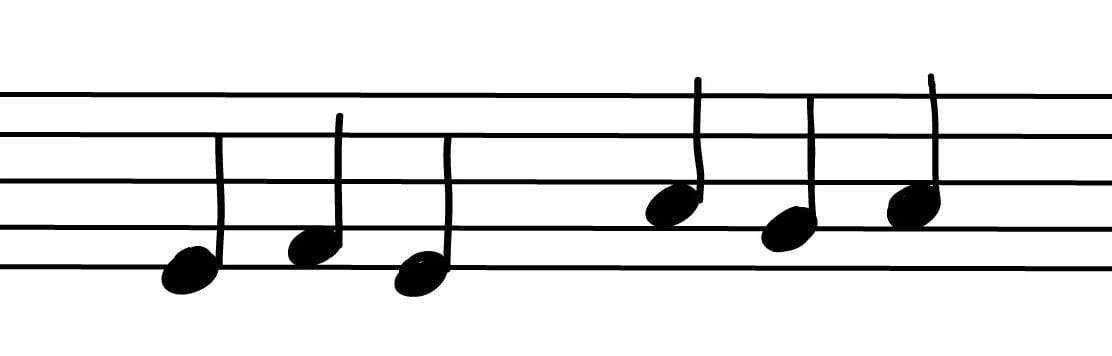
We will be working entirely with intervals. From the note you are playing, how far away is the next note? and is it up or down? The closest note, up or down, is called a second. A second in either direction from a line note will be the nearest space note, and vice versa. The first interval here is a second up; the new note becomes the starting note for figuring the next interval, which is a second down (and that gets us back to where we started). The next set is second-down, second-up.
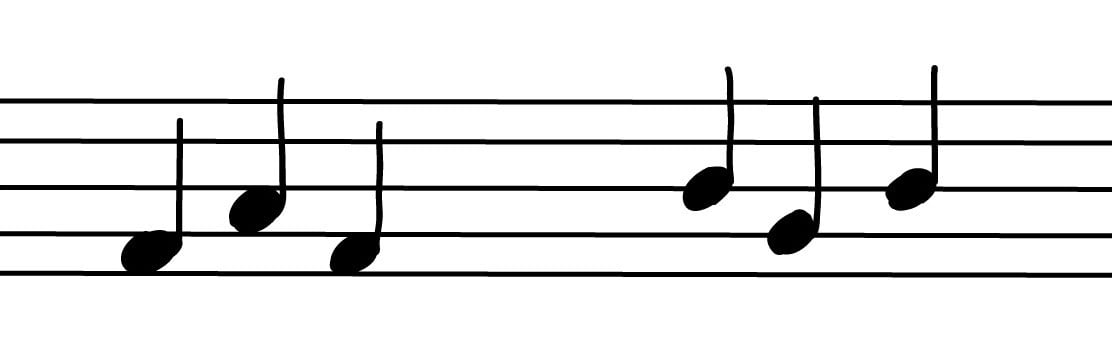
Next, thirds. Any space note to the nearest space note, up or down, is a third (skips the second), and the same follows for line notes. Here is third-up, third-down, then third-down, third-up.
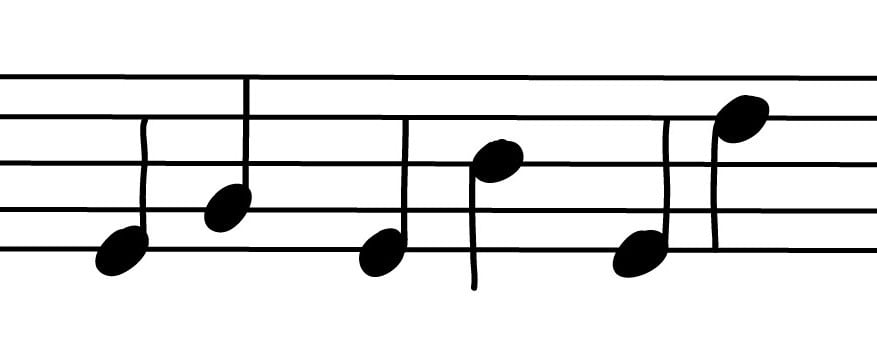
Intervals go on forever, but we will be concentrating on seconds and thirds. In an entire set of intervals, from any line note to other line notes (up or down), we have a third, a fifth, a seventh, etc.; they go up by twos. Name them: third-up, third-down, fifth-up, fifth-down, seventh-up. Space notes work the same way
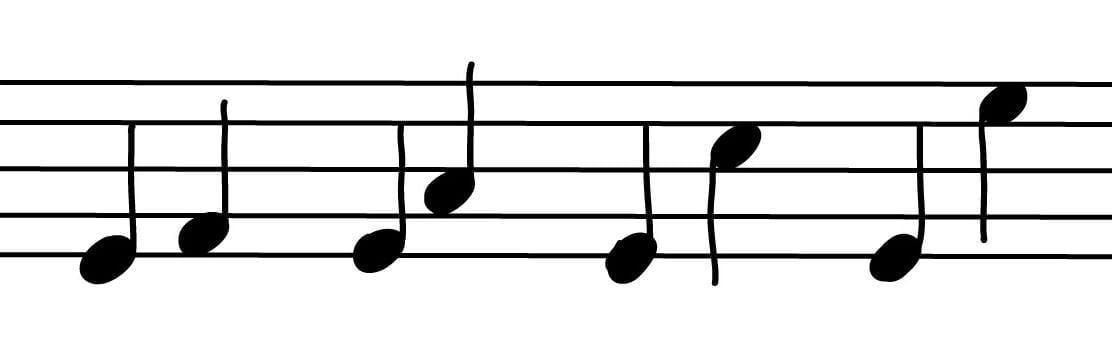
From any line note to space notes, we start with a second, and then there is a fourth, a sixth, and an eighth (octave) for starters—again, going up or down by twos after the first one. Name them: second-up, second-down, fourth-up . . . . Any space note to line notes does the same.
(Extra credit: Identify all the intervals in the first illustration.)
For what follows, you will need a basic harmonica in C—10-hole Richter-tuned diatonic.
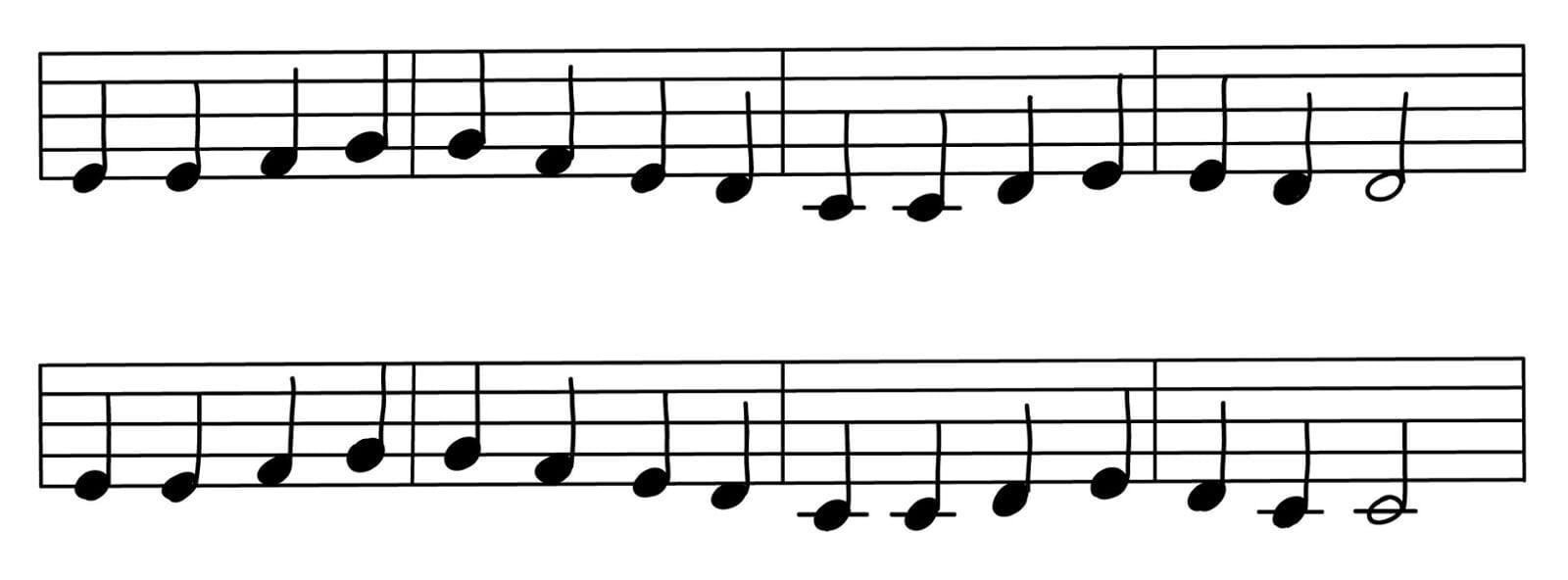
Start at the top left; identify and say out loud the interval from each note to the one after it. We know second-up and second-down; a repeat of the exact same note is officially called unison, but let’s say same and save two syllables. This passage starts out same, second-up, second-up . . . . Keep going.
After you’ve identified all the intervals in these lines, play them! Begin on blow five; play all the intervals and look at them as you play them. (Notes with holes in the heads last longer.)
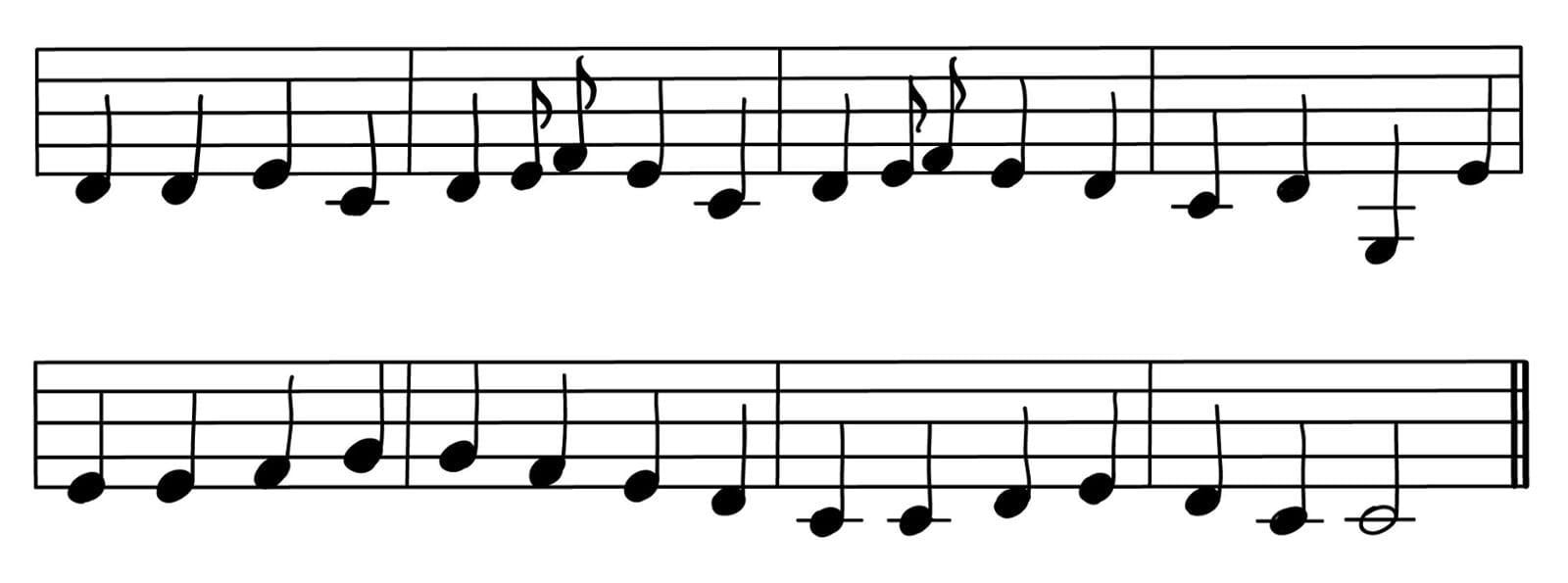
Intervals here will take a little more working out; we meet a fifth and a sixth! Name them out loud: same, second-up, third-down . . . . Start on draw four and play those two lines. (Notes with flags on the stems are shorter.) Then play all four lines.
The bar lines divide the notes into sets of four per measure. The first note in each set is louder; it sounds like one-two-three-four-one-two-three-four, with no pauses or gaps at the bar lines. The notes are called quarter notes. Notes with holes in them last twice as long and are half notes. A four-four symbol (written with one four above the other) at the beginning of the first line of music is the time signature, and it tells you there are four quarter notes per measure throughout.
A note beyond the staff lines gets its very own mini-staff line, not shared with any neighbor notes even if they need the exact same one; these are called leger lines, pronounced ledger and sometimes spelled that way too.
The heavy double vertical line at the end tells you, the end! (Or at least the end of a section.)
There must be a way to fix up the timing near the ends of three of those lines so that a longer plus a shorter note take up the same amount of time as two quarter notes. And there is!
Play those four lines over and over, looking at and identifying the intervals as you go.
Next: proceed to Reading Music 2, the second in this series of four lessons.
♪MJNG
The basics of reading music, intervals and notation, are presented here in a series of four articles written by Mary Jane Gormley. These building blocks were originally presented as a workshop for harmonica players, but are a valuable guide for anyone wanting to learn to read music.
They were later summarized into a series of four short articles intended for print. The articles can be downloaded as PDFs in their original format, or the contents found on the pages of this website.
They were later summarized into a series of four short articles intended for print. The articles can be downloaded as PDFs in their original format, or the contents found on the pages of this website.